What documents do foreigners need for opening a Korean bank account?
Foreigners must present an official Residence Card, previously termed an Alien Registration Card, alongside immigration visa verification to open a domestic account. Opening a Korean bank account is restricted to individuals holding long-term resident visas who have completed domestic foreign registration. Short-term visitors staying under ninety days on travel visas or visa-exempt entries cannot open standard resident checking accounts using only a passport.
Korea expat banking refers to the deposit, debit, and currency services provided by South Korean commercial financial institutions to foreign nationals holding recognized domestic legal residence. For expats holding valid visas for study, business, or skilled employment, banks review your passport, Residence Card, and current proof of employment or local address during your branch appointment. Until your Residence Card is printed and collected from immigration authorities, setting up local accounts, domestic auto-debit payments, and domestic digital banking applications remains on hold. When opening your account, branch tellers can issue an international-enabled domestic debit card, set up account limits, and assist with personal identification certificates necessary for domestic transfers.
Because processing your foreign registration card takes several weeks after arrival, planning your financial steps in advance is essential. Long-term visitors should make sure their international cards carry reasonable foreign transaction charges and verify daily international withdrawal limits with their home providers. Once your resident card is active, you can visit local retail banks in central commercial districts, where staff regularly assist foreign residents with paperwork, mobile banking authorization, and international wire transfer agreements. Having these systems established early ensures smooth handling of living expenses, cell phone subscriptions, and residential rent payments.
How do you manage cash, cards, and ATMs during your first weeks?
Newly arrived travellers manage expenses by pairing international credit or debit cards with cash withdrawn through designated Global ATMs. South Korea is one of the world's most cash-free retail environments. Almost every cafe, grocery store, and retail shop processes foreign credit and debit cards through standard point-of-sale terminals without difficulty. Even taxi drivers across major cities accept payment cards as standard practice.
Cash remains necessary for certain everyday transit functions. Most city buses in Korea do not accept cash and require transit cards such as T-money, which rely on cash reloads. As outlined in VisitKorea's transit guidance, transit cards provide essential connectivity across regional networks. To fund your card, locate automated teller machines marked with foreign network logos or labelled Global ATM at commercial bank branches, major subway stations, and transport hubs. Traditional convenience store ATMs do not always process foreign cards, so using dedicated machines at recognized bank lobbies avoids unnecessary transaction failures during your arrival week.
If you take city buses, remember that most buses in Korea do not accept cash fares directly, making an active transit card mandatory for regular commuting. You board through the front doors, tap your pass on the reader, press the stop button when approaching your destination, and tap out through the rear exit doors. While establishing your local footing and organizing your paperwork in the capital, finding a well-placed base makes daily travel simpler; you can explore residential options such as /en/stays/seoul/seoul-urban-comfort/ to settle near convenient transit lines.
What is the difference between local clinics and general hospitals?
Local neighbourhood clinics handle walk-in consultations for routine ailments, whereas general hospitals manage complex diagnostics through international healthcare coordination centers. For common health complaints such as fever, gastroenteritis, minor sprains, or allergic reactions, visiting a private neighbourhood clinic (의원) is the most efficient choice. Local clinics in commercial districts operate on a walk-in basis. Foreign visitors without national health insurance pay consultation fees directly out of pocket before receiving an itemized medical bill and a written prescription.
After your clinic consultation, take your written prescription to any adjacent community pharmacy, where the pharmacist dispenses your medication in individually sealed dose packets. If you require specialized investigations or complex therapies, tertiary hospitals operate dedicated international coordination departments. As detailed in the VisitKorea Medical Provider Directory, these international centers connect foreign patients with professional medical interpreters and facilitate appointments across advanced hospital networks. Many university facilities and specialist centers provide interpretation support in English, Chinese, and Japanese, allowing patients to review diagnostic results, consent forms, and treatment options clearly.
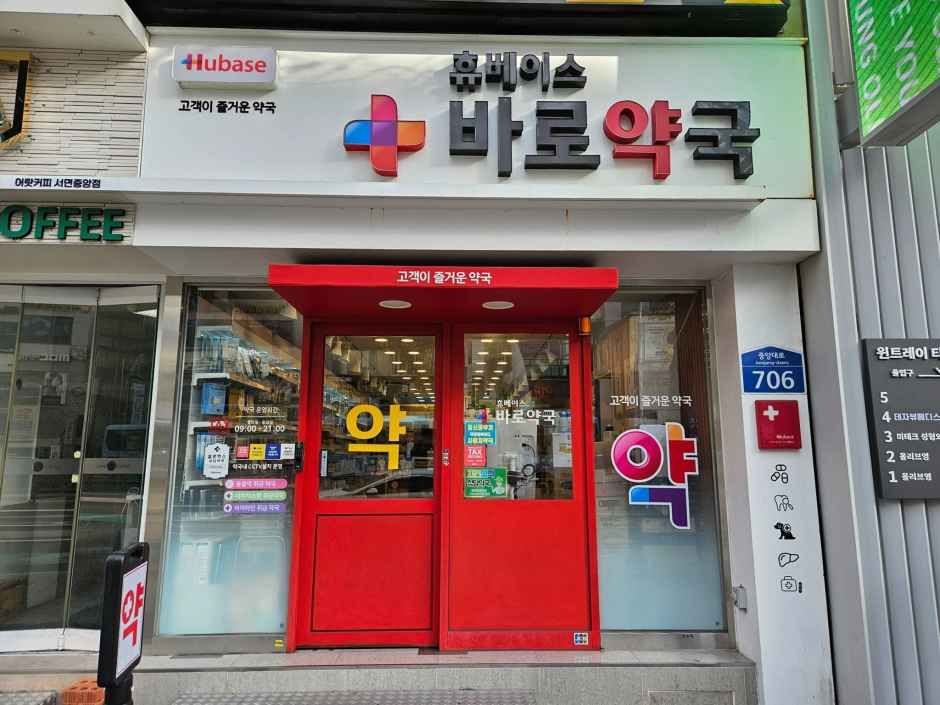
For mild symptoms that do not require a clinic consultation, finding over-the-counter remedies is straightforward. According to the VisitKorea Pharmacy Guide, travellers seeking English speaking pharmacies Seoul locations should watch for storefront signs stating Language assistance available in popular districts. Bringing a photograph of your regular medicine box or writing down the active ingredient allows pharmacists to find an exact domestic equivalent. Using mobile translation tools to explain your specific symptoms or allergies is standard practice and welcomed by staff.
Pharmacies around major subway hubs like Hongik University Station (홍대입구역) frequently maintain extended operating hours and stock practical remedies for headaches, nausea, or travel fatigue. If you fall ill immediately upon landing or before catching a domestic connection, clinics and pharmacies operate inside terminals at hubs like Gimpo International Airport (김포국제공항) and Incheon International Airport.
Frequently asked questions
Can tourists on ninety-day tourist visas open a Korean bank account?
Tourists on ninety-day tourist visas cannot open a standard local checking account in South Korea. Domestic banks legally require foreign customers to present an Alien Registration Card or Residence Card alongside certified visa verification. Short-term visitors should rely on international payment cards and cash drawn from Global ATMs.
How do you communicate your symptoms at a local Korean pharmacy?
You can communicate symptoms by showing the pharmacist the primary active ingredient names written down, using a digital translation app, or showing a clear photo of your home medication packaging. In busy international commercial areas, select pharmacies display signs stating that language assistance is available.
Do you need an appointment to visit a local clinic in Korea?
You do not need an appointment for standard primary care at a neighbourhood clinic. You register at the front desk with your passport, see a doctor, pay out of pocket, and take your paper prescription to a nearby pharmacy.
What should you do if you need medical care right after landing at the airport?
Major airport hubs provide walk-in medical services directly within passenger terminals. Both Gimpo International Airport and Incheon International Airport maintain terminal pharmacies and primary medical clinics capable of evaluating common travel sickness, prescribing medication, and providing rapid first-aid care.
Updated 10 November 2026
Sources
- VisitKorea Pharmacy Guide: **Finding English-speaking pharmacies & OTC medications**: Official travel health guidelines advise international travellers seeking over-the-counter medicine to look for pharmacies located near popular hubs displaying signs stating “Language assistance available” When visiting local pharmacies, showing photos of packaging, specifying key active ingredients, or using mobile translation tools helps pharmacists dispense direct domestic equivalents Carrying digital or paper copies of home prescriptions and medical summaries is recommended if condition management requires complex care **Local clinics vs. general hospitals**: Neighbourhood private clinics (*uiwon*) handle primary triage, out-of-pocket walk-in consultations, and standard non-urgent issues, and will write prescriptions fulfilled at adjacent pharmacies
- VisitKorea Medical Provider Directory: Larger tertiary/general hospitals require English-speaking international healthcare coordination centers, which are designed for specialized diagnostics or referrals
- VisitKorea's transit guidance: Major travel hubs like international airports also maintain designated domestic-terminal clinics and pharmacies for rapid primary evaluations **Managing cash and ATMs**: Korea operates virtually cashless across retail, yet transit cards like T-money rely on cash reloads